Hire Someone to Apply for Jobs: 4 Options Compared (2026)
The four services that apply for jobs on your behalf — compared by callback rate, cost per interview, and who each is actually for. Real 2026 pricing, verified data, and red flags to avoid.
The average job posting in 2026 receives 250 applications. Only 2–3% of those applicants make it to the interview stage. And the average job seeker needs to send roughly 42 applications just to land one interview — a process that takes 15–20 hours per week. No wonder people are outsourcing it.
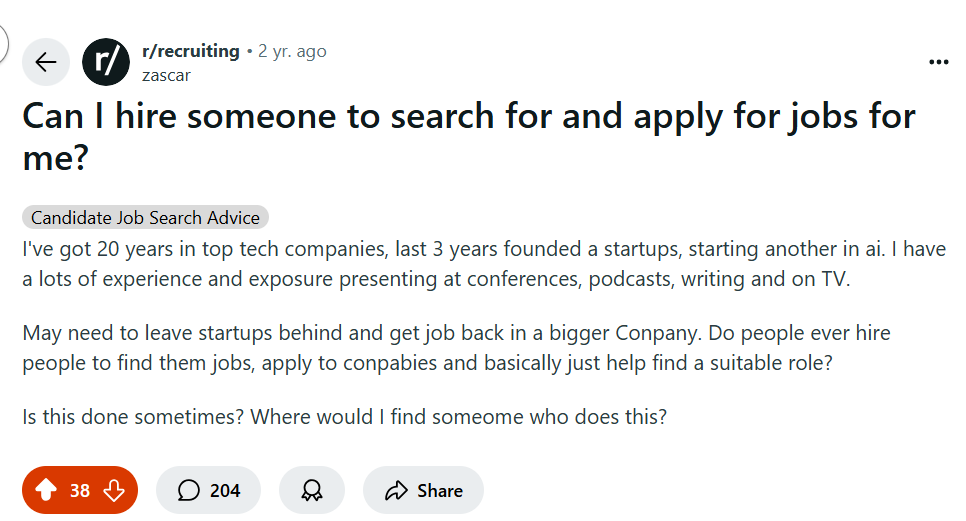
Yes, you can hire someone — or use a service — to search and apply for jobs on your behalf. It's legal, it's increasingly common, and done right it's no different from hiring an accountant to file your taxes. This guide covers every option available in 2026, with real pricing, honest pros and cons, and the red flags that separate legitimate services from scams.
Is it legal (and ethical) to hire someone to apply for jobs?
Yes, on both counts — with one important condition. You're submitting your real resume, your real experience, and your real qualifications. Someone else is handling the administrative labour of finding matching roles and filling out forms. That's no different from having a PA manage your inbox.
The ethical line is crossed when the service misrepresents your qualifications, applies to roles you're clearly not suited for, or submits fabricated information. A good service applies accurately and only to roles you genuinely fit. You still interview — and you still do the job.
The 4 types of services that apply for jobs on your behalf
1. Reverse recruiters
A reverse recruiter works for you, not for employers. They handle everything: finding roles, tailoring your resume per application, submitting, and even doing outreach to hiring managers on your behalf. Think of them as a dedicated job search manager.
| Details | |
|---|---|
| Cost | $1,500–$5,000/month or $2,000–$10,000 flat fee |
| Best for | Senior professionals, executives, career changers |
| Time to results | 4–12 weeks typically |
| Quality | High — human, personalized, targeted |
- Pro: Access to unadvertised roles via direct recruiter outreach (60–70% of openings are never publicly posted).
- Pro: Clients report landing roles 2–4x faster than solo searching.
- Con: Expensive — most packages run $2,000+ before you see a single result.
- Con: Quality varies enormously. Many firms outsource work to inexperienced freelancers abroad despite charging premium prices.
- Con: No guarantee of a job offer — reputable services only promise interviews.
2. Freelancers (Fiverr, Upwork)
Freelancers on gig platforms will apply to jobs on your behalf for a flat fee. You hand over your resume, give them your job criteria, and they submit applications in bulk.
| Details | |
|---|---|
| Cost | $45–$500 per project (e.g. 100 applications) |
| Best for | Budget-conscious job seekers, early career |
| Time to results | 1–2 weeks for applications; interviews vary |
| Quality | Variable — depends heavily on the individual |
- Pro: Affordable — some Fiverr sellers charge as little as $45 for 100 applications.
- Pro: Fast turnaround on volume.
- Con: Most use a one-size-fits-all resume with no per-job tailoring.
- Con: No accountability — low-quality submissions can get your profile flagged by ATS systems.
- Con: Difficult to vet quality upfront; results are inconsistent.
3. AI auto-apply tools
These tools use AI to scan job boards, match roles to your profile, and auto-submit applications — often while you sleep. The appeal is volume: some tools apply to hundreds of jobs per week automatically.
| Details | |
|---|---|
| Cost | $20–$300/month |
| Best for | High-volume job seekers, tech roles on major boards |
| Time to results | Applications fast; interviews depend on quality |
| Quality | Low-to-medium — fast but minimal personalization |
- Pro: Cheap and fast — you can be applying to 50+ roles per day automatically.
- Pro: Works 24/7, no manual effort required after setup.
- Con: Most send the same CV to every job — zero tailoring per role.
- Con: High volume with no targeting can trigger spam filters and damage your reputation with recruiters.
- Con: Struggles with enterprise ATS platforms (Workday, Greenhouse) that require custom form fields.
4. Human-assisted AI services (e.g. Jobr)
A newer category that sits between pure automation and full reverse recruiting. AI handles matching and application volume; human reviewers ensure quality before submissions go out. This is how Jobr works — you can see the plans and what is included on Jobr's apply-for-me page.
| Details | |
|---|---|
| Cost | $99–$299/month |
| Best for | Most job seekers who want quality + volume |
| Time to results | Applications within days; interviews typically 2–6 weeks |
| Quality | High — AI efficiency with human quality control |
- Pro: Every application is reviewed by a human before submission — no spam-quality submissions.
- Pro: AI matching finds relevant roles you'd likely miss manually.
- Pro: Full transparency — you see every job applied to.
- Con: Not as fast as pure auto-apply tools.
- Con: Costs more than a basic AI tool, though far less than reverse recruiting.
Callback rates and cost per interview: what the data shows
These figures come from Scale.jobs' 30-day comparison test and FastApply's 2026 tool analysis. Cost-per-interview is calculated from typical volume and callback rates — use it as a planning guide, not a guarantee.
| Service type | Apps/month | Avg callback rate | Monthly cost | Est. cost per interview |
|---|---|---|---|---|
| AI auto-apply bot | 300–1,000 | 1–6% | $30–$150 | $0.50–$15 |
| Freelancer (Fiverr/Upwork) | 100–500 | 2–5% | $45–$500/project | $2–$25 |
| Human-assisted AI (e.g. Jobr) | 50–150 | 15–30% | $99–$299 | $2–$40 |
| Reverse recruiter | 20–50 targeted | 40–60% | $1,499–$5,000 | $50–$375 |
Which option is right for you?
| Your situation | Best option |
|---|---|
| Senior/executive role, $100k+ salary target | Reverse recruiter |
| Early career, tight budget | AI auto-apply tool or Fiverr freelancer |
| Mid-career, want quality + volume | Human-assisted AI (Jobr) |
| Just need to explore the market quickly | AI auto-apply tool |
| Career change, need strategy + applications | Reverse recruiter |
Red flags: how to spot a scam service
Employment scams are rising. The FTC received more than 25,000 job scam reports in Q4 2025 alone, with $150 million lost and a median victim loss of $2,000. AI has made fake services harder to detect — professional-looking websites and convincing chatbots can now be set up in hours. Watch for these warning signs before paying anything:
- They guarantee a job offer. No legitimate service can guarantee employment — they control applications, not hiring decisions.
- Large upfront payment before showing you anything. Legitimate services should offer examples, references, or a trial period.
- They cannot show you which jobs they applied to on your behalf. Full transparency is non-negotiable.
- They ask for sensitive personal information (SSN, bank details) during onboarding.
- Contact comes from a @gmail or @yahoo address rather than a company domain.
- Mass-applies to hundreds of roles with zero filtering — this damages your professional reputation and can get you blacklisted by companies.
- No verifiable reviews, no real team page, no company history.
What to realistically expect
Hiring a service to apply for jobs is not a shortcut to an offer. It's a shortcut to a full pipeline. You still need to:
- Prepare for interviews — the service gets you in the room, you still have to perform.
- Stay actively involved — review what's being applied to, give feedback, adjust targeting.
- Be patient — most job seekers see their first interview in 2–6 weeks, not 2–6 days.
- Maintain your LinkedIn — recruiters will look you up after an application lands.
The best job search service gets you more at-bats. You still have to hit the ball.
Frequently Asked Questions
Is it legal to hire someone to apply for jobs for me?
Yes, completely legal. You're outsourcing administrative work — searching and form-filling — while your real qualifications, experience, and identity are what gets submitted. The same way you might hire someone to write your resume, you can hire someone to submit it.
How much does it cost to hire someone to apply for jobs?
It depends on the service type. Freelancers on Fiverr charge $45–$500 per project. AI auto-apply tools cost $20–$300/month. Human-assisted AI services like Jobr run $99–$299/month. Full reverse recruiters charge $1,500–$5,000/month or $2,000–$10,000 as a flat fee.
Will employers know someone else applied for me?
No. From the employer's perspective, an application arrives with your name, resume, and contact information — same as if you'd applied yourself. The difference is who clicked submit and filled in the forms.
Does hiring someone to apply for jobs actually work?
Yes, when the service focuses on quality and targeting. Job seekers who outsource to targeted services report landing interviews 2–4x faster than those applying manually. Services that mass-apply with no tailoring can actively hurt your chances.
What's the difference between a reverse recruiter and an AI job application service?
A reverse recruiter is a dedicated human professional who manages your entire job search — research, applications, networking, outreach. An AI service automates the submission step. Reverse recruiters cost $2,000–$10,000; AI services cost $20–$300/month.
Is it worth paying for a job application service?
If you're spending 15–20 hours per week on job searching with no results, yes. A good service pays for itself in recovered time and a faster pipeline. For a $100k role, being hired one month sooner covers most reverse recruiter costs.
What should I look for in a job application service?
Full transparency on every application submitted, per-job resume tailoring, human review before submission, verifiable user reviews, and no guarantee of a job offer (that's a red flag, not a feature).